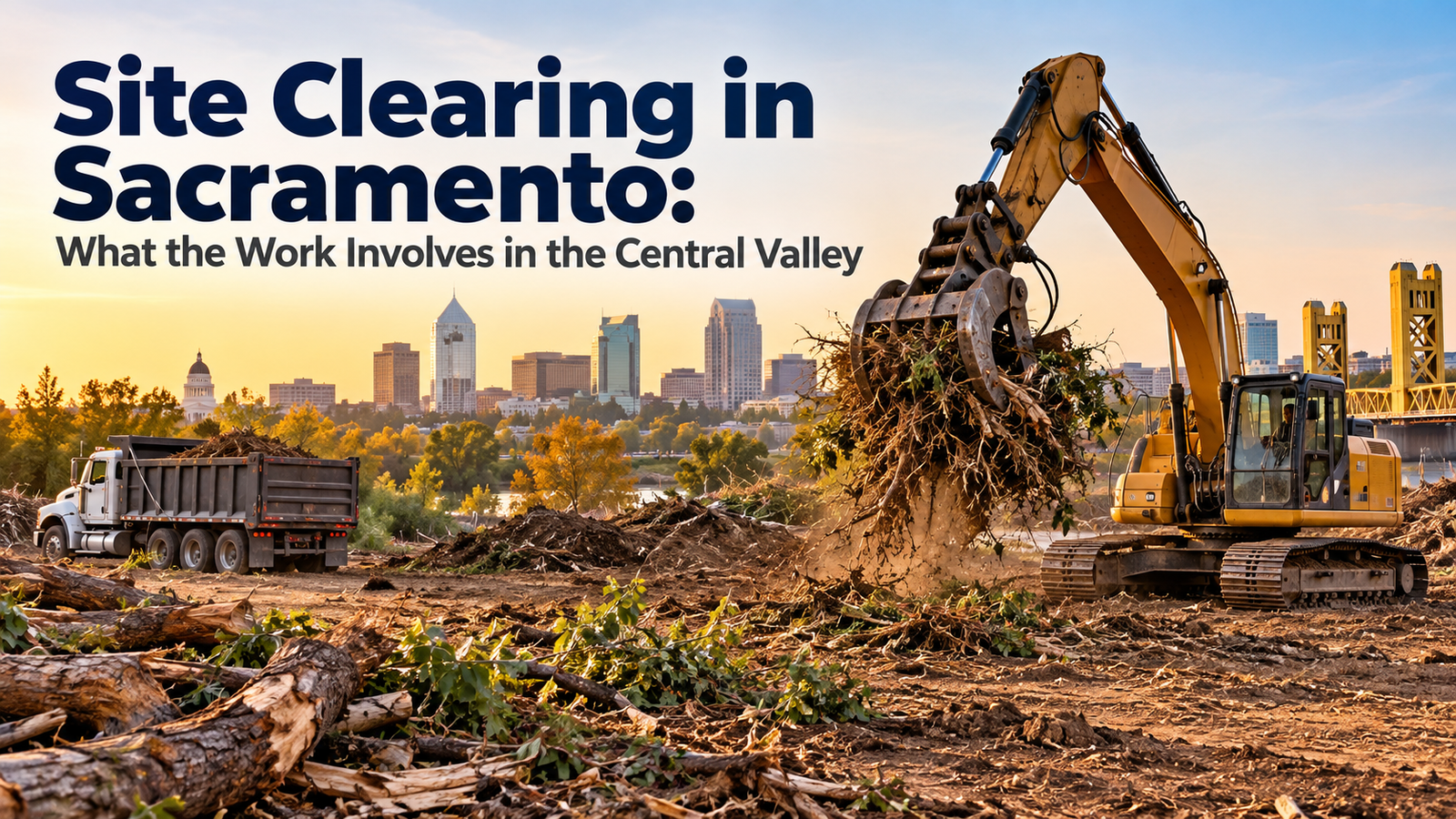
Site clearing is the process of removing all surface and near-surface obstructions from a parcel to prepare it for construction, grading, or another use. In Sacramento, this means working in a specific physical context: the Sacramento Valley floor, with its heavy clay soils, seasonal flooding history, dense riparian vegetation along waterway corridors, and a regulatory environment that reflects California’s comprehensive approach to environmental protection. Site Clearing Sacramento is not simply mechanical work it is a permitted activity that intersects with SWPPP requirements, SMAQMD air quality rules, and in many cases biological resources regulations that govern what can be cleared, when, and how.
Understanding what professional site clearing actually involves in Sacramento what equipment does the work, what regulatory requirements apply, and what the soil and vegetation conditions in the valley create as operational challenges gives property owners, developers, and contractors a realistic basis for planning clearing projects in the region.
What Site Clearing Includes
A full site clearing project removes trees, shrubs, brush, ground cover vegetation, root masses, debris, surface rocks, and any other material that would interfere with subsequent grading or construction. The scope varies by site: an undeveloped agricultural parcel near Elk Grove needs different clearing than a commercial infill lot in Midtown Sacramento that carries legacy structures, utility remnants, and disturbed urban fill.
Tree removal in site clearing involves felling, sectioning, and removing trunks, large branches, and stumps. Stump removal may be by grinding reducing the stump to chips in place or by excavation, which removes the stump and root mass entirely. Full excavation is required when building foundations or paved areas will be placed where stumps sat, because decaying root mass creates voids as it decomposes, leading to settlement in pavement or structural footings placed above.
Brush and shrub clearing is done with tracked forestry mulchers, bulldozer-mounted brush rakes, and skid-steer attachments. In the Sacramento Valley, native riparian vegetation willows, cottonwoods, valley oaks, and associated shrubs grows densely along creek and drainage channels. Clearing near these corridors requires attention to regulatory setbacks and biological surveys to ensure that regulated vegetation is not removed without appropriate permits.
Sacramento Valley Soils and Site Clearing Challenges
The Sacramento Valley floor consists of deep alluvial deposits laid down by the Sacramento and American rivers over thousands of years. The dominant soil series in the Sacramento urban area include heavy Stockton clays and Sacramento silty clays soils that are notoriously difficult to work when wet and that crack severely when dry. The Vertisol character of these soils deep shrink-swell cycling means that site conditions change substantially with season and moisture status.
In winter and spring, when Sacramento receives most of its annual precipitation and when valley soils are saturated, site clearing is constrained by trafficability. Heavy tracked equipment can work in wet conditions better than wheeled equipment, but even tracked machines can compact saturated Vertisol soils severely, creating subsurface damage that affects subsequent agricultural use or construction subgrade preparation. Many Sacramento clearing projects are scheduled for the dry season May through October to avoid soil compaction in saturated conditions.
Summer and fall clearing in the Sacramento Valley involves the opposite challenge: extremely hard, cracked soils that require significant machine effort to penetrate. Root systems in hard, dry Vertisol are difficult to remove because the soil contracts tightly around roots, holding them in place. Stump excavation in hard-dry Sacramento clay is mechanically demanding and typically requires a large excavator with hydraulic rock hammer or root grapple capability.
SWPPP Requirements for Site Clearing in Sacramento
Any land disturbance project disturbing one acre or more in California is subject to the Construction General Permit under the State Water Resources Control Board’s NPDES stormwater program. The permit requires a Stormwater Pollution Prevention Plan SWPPP that identifies sources of pollutants from the clearing activity, specifies Best Management Practices to prevent those pollutants from entering storm drains or waterways, and documents an inspection and maintenance program.
In Sacramento, smaller projects disturbing less than one acre may still require a SWPPP or equivalent erosion control plan under the City of Sacramento’s Grading, Erosion and Sediment Control Ordinance. The Sacramento Stormwater Quality Partnership enforces stormwater quality requirements on construction sites within the urban area, conducting inspections and issuing enforcement actions for sites that fail to implement or maintain required BMPs.
Common BMPs for Sacramento clearing sites include silt fence along down-slope perimeters, fiber rolls or gravel bag berms at drainage concentrate points, stabilized construction entrances to prevent tracking of mud onto public streets, and hydroseeding or erosion control blankets on cleared areas that will not receive immediate construction. These measures are not optional they are permit conditions with inspection and enforcement consequences.
Air Quality Requirements: SMAQMD and Dust Control
The Sacramento Metropolitan Air Quality Management District regulates construction dust as a component of particulate matter emissions in the Sacramento Valley, which is a designated nonattainment area for PM2.5 and ozone. Dust generated by site clearing from vegetation removal, ground disturbance, and vehicle traffic on unpaved surfaces is subject to SMAQMD Rule 403, which requires specific dust control measures during all clearing and grading operations.
Rule 403 dust control requirements for site clearing include watering exposed soil surfaces at least twice daily during active clearing, watering unpaved access roads used by clearing equipment, applying chemical dust suppressants when watering is insufficient, and preventing visible dust from crossing property boundaries. Violations are subject to penalties, and SMAQMD can issue notice of violation orders that stop clearing work.
Smoke from vegetation burning is separately regulated under SMAQMD’s open burning rules and the California Air Resources Board. In Sacramento County, agricultural and land clearing burning requires SMAQMD permits, is prohibited on Spare the Air days, and in many cases is prohibited altogether for urban and suburban clearing projects where air quality concerns make burning unacceptable. Grinding and chipping vegetation for mulch or disposal at a green waste facility is the standard alternative to burning in the Sacramento urban area.
Biological Surveys and Nesting Bird Season in Sacramento
California’s biodiversity regulations create biological resource considerations for site clearing projects in the Sacramento area. The California Environmental Quality Act requires disclosure and mitigation of impacts to biological resources as part of project environmental review. Sites in or adjacent to riparian corridors, wetlands, vernal pools, or areas of native vegetation may require biological surveys before clearing begins.
Nesting bird season is a significant operational constraint for Sacramento clearing projects scheduled in spring and summer. The Migratory Bird Treaty Act and California Fish and Game Code both protect active bird nests and eggs from disturbance. Vegetation clearing in the Sacramento area during the nesting season generally February 1 through August 31 requires a pre-clearing nest survey conducted within 72 hours before clearing begins. If active nests are found, clearing must avoid the nest site until the young have fledged, typically 30 to 60 days depending on species.
Valley oak and blue oak trees in the Sacramento area are subject to additional protections under some local ordinances. The City of Sacramento’s Heritage Tree Ordinance requires permits before removing or severely pruning heritage-designated oaks. Sutter and Yolo counties have similar protections for valley oaks in rural and suburban areas. Clearing projects that include oak removal should verify whether the trees trigger heritage or protected tree requirements before work begins.
Debris Disposal and Green Waste Processing in Sacramento
Vegetation cleared from Sacramento sites can be processed in several ways. Woody material suitable for biomass energy generation can go to facilities that accept green waste for energy recovery. Garden-quality green waste brush, leaves, and small-diameter wood goes to regional green waste composting facilities. Large timber may have value as wood products and can be sold or donated to salvage buyers.
Sacramento County operates green waste recycling programs that accept cleared vegetation at transfer stations. Private green waste processors in the region accept larger volumes from commercial clearing projects. Tipping fees and acceptance criteria vary by facility and by the cleanliness of the material vegetation mixed with soil, rock, or construction debris typically commands higher tipping fees or may be rejected from clean green waste streams.
Frequently Asked Questions: Site Clearing in Sacramento
What permits are required for site clearing in Sacramento?
Grading permits from the City or County, SWPPP coverage under the Construction General Permit for disturbances over one acre, SMAQMD compliance for dust control, and potentially biological survey requirements and heritage tree permits depending on site conditions.
Why is scheduling site clearing for summer important in the Sacramento Valley?
Sacramento’s Vertisol soils are trafficable when dry. Winter and spring clearing in saturated soils risks severe compaction damage and operational difficulties. Dry-season clearing allows equipment to work effectively without damaging the subgrade.
What is SWPPP and when is it required?
A Stormwater Pollution Prevention Plan identifies pollutant sources from clearing activity and specifies Best Management Practices to prevent those pollutants from entering storm drains. Required for disturbances over one acre under the state Construction General Permit, and in some cases for smaller projects under local ordinances.
Does nesting bird season affect when clearing can begin in Sacramento?
Yes. Vegetation clearing during the February 1 through August 31 nesting season requires a pre-clearing nest survey within 72 hours. If active nests are found, clearing avoids the nest until young have fledged.
How is cleared vegetation disposed of in Sacramento?
Green waste composting facilities, biomass energy facilities, salvage buyers for timber, or green waste programs at county transfer stations. Burning is prohibited for most urban and suburban clearing projects in Sacramento County.
Site clearing in Sacramento combines straightforward mechanical work with a regulatory and environmental context specific to the Sacramento Valley. Professional clearing contractors in the region understand the soil conditions, the seasonal constraints, the SWPPP and SMAQMD requirements, and the biological resource considerations that shape how clearing projects are planned and executed.